The scene looked like something out of a movie.
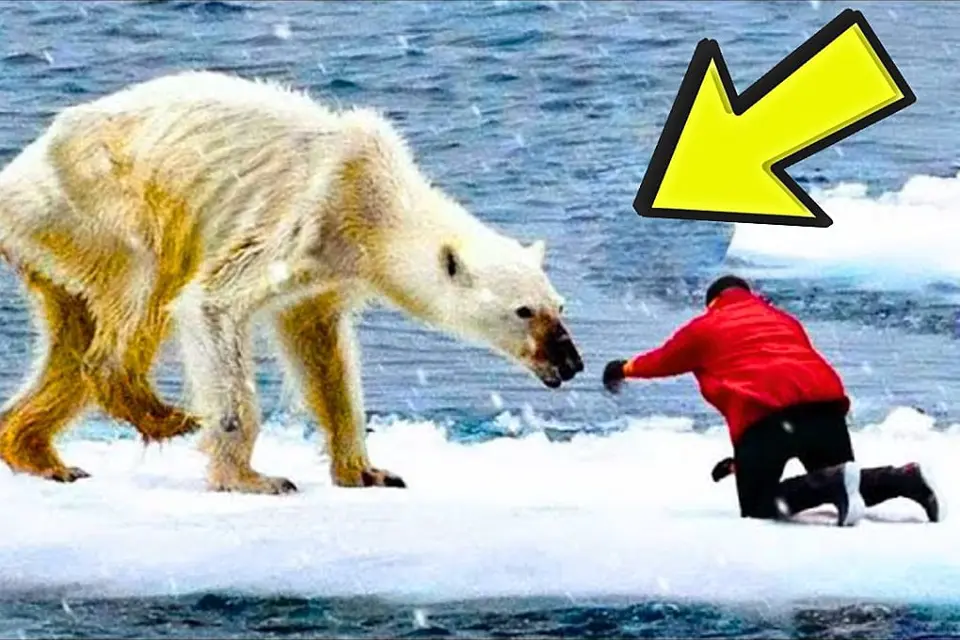
A lone polar bear stood on the frozen shoreline, appearing weak and exhausted. Nearby, a person in a bright red jacket was down on the ice, facing the enormous animal.
For a moment, it looked as though the person had made an impossible decision: approach one of the Arctic’s most powerful predators when it appeared to be in trouble.
But there was much more to the situation than the photograph seemed to show.
The Bear Didn’t Look Like It Normally Would
A healthy polar bear is an impressive sight.
These enormous Arctic mammals are powerful swimmers, excellent hunters, and highly adapted to surviving in one of the world’s harshest environments.
But the animal in the photograph appears extremely thin.
Its coat looks dirty, its body appears lean, and its posture suggests exhaustion.
For an animal that depends heavily on stored body fat to survive Arctic conditions, extreme thinness can be a serious warning sign.
Polar bears normally build energy reserves by feeding on prey, particularly seals. When food becomes difficult to find, they can lose substantial amounts of body mass.
And once an animal becomes severely weakened, finding food becomes even more difficult.
It’s a dangerous cycle.
Then the Person Moved Closer
The most striking part of the image isn’t actually the bear.
It’s the person.
Instead of immediately running away, the person appears to be facing the animal at close range.
That creates an obvious question:
Why would anyone get that close to a polar bear?
Polar bears are wild predators, and approaching one can be extremely dangerous.
Even an apparently sick or exhausted animal can move quickly and react unpredictably.
A person attempting to physically rescue a wild polar bear without professional equipment or authorization could put both themselves and the animal in danger.
That’s why real wildlife rescues are generally handled by trained professionals rather than members of the public.
A Weak Animal Can Still Be Dangerous
One of the biggest misconceptions about wildlife emergencies is that a sick-looking animal is automatically harmless.
That’s not true.
A frightened or starving animal may become defensive because it feels threatened.
For a polar bear, the stakes are even higher.
These animals have enormous physical strength and powerful jaws. A person who gets too close could be attacked even if the original intention was simply to help.
So if someone encountered a struggling polar bear in the wild, the safest response would generally be to maintain distance and contact appropriate wildlife authorities.
But What Could Have Happened Next?
Imagine the situation from the person’s perspective.
The bear is visibly struggling.
The ocean is behind it.
The landscape is almost completely covered in snow and ice.
There is nowhere obvious for the animal to find shelter or food.
The person wants to help—but doesn’t know whether approaching will make things better or worse.
That is where wildlife rescue becomes incredibly complicated.
Helping a wild animal isn’t as simple as giving it food or water.
Professionals have to determine why the animal is struggling in the first place.
It could be starvation, illness, injury, dehydration, environmental stress, or another problem.
Treating the wrong problem can sometimes make matters worse.
Why Feeding a Wild Polar Bear Isn’t the Answer
It might seem logical to give a starving animal food.
But feeding wildlife can create serious problems.
A wild predator that begins associating humans with food may become more willing to approach people in the future.
That can put both humans and the animal at risk.
Professional wildlife teams therefore have to consider much more than the immediate emergency.
Their goal isn’t simply to keep an animal alive for another day.
They also have to consider whether the animal can eventually survive on its own.
The Real Challenge Comes After the Rescue
Even if a weak polar bear could be safely captured, the work wouldn’t end there.
Veterinary specialists might need to assess:
- Body condition
- Injuries
- Hydration
- Infection
- Blood chemistry
- Internal health
- Nutritional condition
- Possible causes of weakness
A treatment plan would depend on what those examinations revealed.
And because polar bears are wild animals, handling them requires specialized procedures and equipment.
This is very different from helping an injured domestic animal.
The Ending Isn’t Always What People Expect
Here’s the part that makes stories like this so emotional.
People naturally want a dramatic ending where the animal is rescued, becomes healthy again, and somehow returns to the person who saved it.
Real wildlife conservation rarely works that way.
If a polar bear is successfully rehabilitated, the ultimate goal may be to return it to an appropriate natural environment—not to create a permanent relationship with the person who helped.
That’s because the bear isn’t a pet.
It belongs in the wild.
And That Changes the Meaning of the Photograph
A photograph like this can easily create a story in your mind.
You see the person.
You see the bear.
You see the dramatic arrow pointing toward the encounter.
Immediately, your brain fills in the missing details.
Maybe the person rescued the bear.
Maybe the bear was dying.
Maybe something extraordinary happened afterward.
But photographs don’t provide all of that information.
Without reliable documentation about when and where an image was taken, who is pictured, and what happened afterward, it’s impossible to know whether the dramatic story attached to an image is accurate.
That’s an important lesson when viewing viral wildlife photographs online.
Polar Bears Face a Difficult Environment
Regardless of the story behind a particular photograph, polar bears really do face significant challenges in the Arctic.
They depend heavily on sea ice for hunting seals and moving through their environment.
When conditions change, finding food can become more difficult.
A bear that loses too much body weight can become increasingly vulnerable.
That makes photographs of extremely thin polar bears particularly powerful—but also easy to misunderstand.
A single image can show that an animal looks unhealthy without revealing the underlying cause.
The Best Way to Help Wildlife
If you ever encounter a wild animal that appears injured, sick, or exhausted, the instinct to help is understandable.
But direct intervention isn’t always the best option.
Instead:
Keep your distance.
Don’t attempt to feed the animal.
Don’t corner or chase it.
Keep other people away.
Contact local wildlife authorities or qualified professionals.
This approach protects you while giving trained specialists the opportunity to determine what should happen next.
The Unbelievable Part
The most unbelievable thing about encounters like this isn’t necessarily that a person can walk up to a wild animal and save it.
It’s that humans and wildlife can cross paths in situations where one decision can dramatically change the outcome.
A weak polar bear may look helpless.
But it remains a powerful wild predator.
And the person standing nearby may be trying to help—but could just as easily make the situation more dangerous without professional guidance.
That’s why genuine wildlife rescues require patience, expertise, and respect for the animal’s natural behavior.
One Photograph, A Thousand Questions
The image may leave you wondering what happened next.
Did the bear survive?
Was it actually rescued?
Who was the person?
Where was the photograph taken?
Was the animal really dying?
Those questions are exactly what makes dramatic wildlife photographs so compelling.
But before believing an unbelievable story attached to a viral image,