Modern warehouses need more than just extra space—they need storage systems that are safe, efficient, durable, and suited to the way a business actually operates. Whether you’re looking for used, new, or custom warehouse racking, the right choice can make a major difference in storage capacity and workflow.
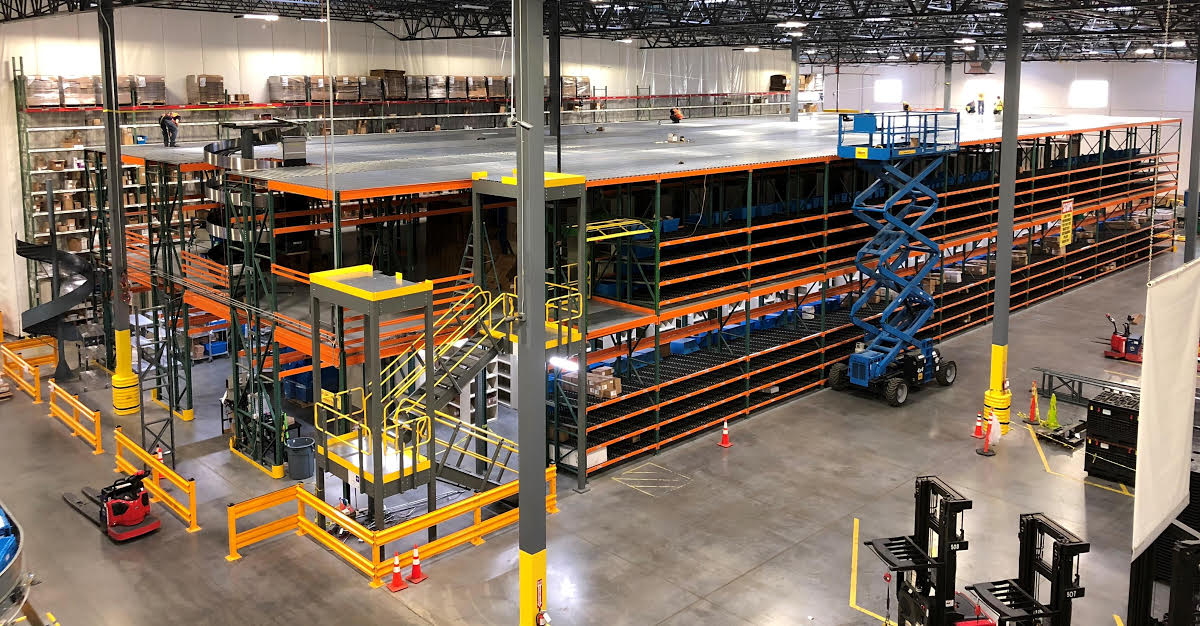
The warehouse shown here features extensive pallet racking, mezzanine-style storage areas, stairs, safety barriers, and material-handling equipment—an example of how a facility can use vertical space to increase storage capacity.
Used Warehouse Racking
Used pallet racking can be an attractive option for businesses trying to control costs or expand an existing warehouse system.
Quality used racks can perform effectively when they are:
- Thoroughly inspected before installation
- Free from significant bends, cracks, or structural damage
- Properly matched to the intended load
- Compatible with existing rack components
- Installed and anchored correctly
Used systems can also be useful when a business needs standard components quickly. However, buyers should never assume that two rack components are compatible simply because they appear to fit together.
New Warehouse Racking
New racking is often the better choice when a facility requires a specific configuration, higher customization, manufacturer documentation, or a completely new warehouse layout.
New systems can be designed around:
- Ceiling height
- Pallet dimensions
- Product weight
- Forklift requirements
- Aisle width
- Available floor space
- Future expansion plans
New racking also makes it easier to create a consistent system throughout a facility and obtain documentation for the specific configuration.
Custom Racking for Unique Warehouse Needs
Not every warehouse has the same layout. Custom storage solutions can be designed to make better use of unusual building dimensions, available vertical space, or specialized inventory requirements.
Depending on the operation, a custom system might include:
- Selective pallet racks
- High-bay storage
- Mezzanine platforms
- Cantilever racks
- Push-back systems
- Pallet-flow systems
- Custom work platforms
- Safety gates and guardrails
Modern pallet racking is highly modular, allowing systems to be adapted to different warehouse footprints and operational requirements.
What Should You Choose?
The best option depends on your budget, warehouse layout, inventory, and long-term plans.
Choose used when saving money is important and suitable, inspected components are available.
Choose new when you need specific dimensions, documentation, warranty coverage, or a completely new configuration.
Choose custom when your warehouse has unusual dimensions or your storage requirements don’t fit a standard system.
Safety Comes First
Regardless of whether your racking is new or used, safety should never be sacrificed for a lower price. Inspect frames and beams for damage, verify load information, ensure compatible components are used, and have the completed system properly installed.
Used racking can be a practical solution, but it should be treated as structural equipment—not simply as inexpensive second-hand steel.
Final Thoughts
Used, new, and custom warehouse racking each have their advantages. The smartest investment isn’t necessarily the cheapest option; it’s the system that safely provides the storage capacity, accessibility, and flexibility your operation needs.
Before purchasing, evaluate your current inventory, load requirements, available space, future growth, and installation requirements. A properly planned racking system can help transform unused vertical space into valuable warehouse capacity.