Think you have a sharp eye and a great sense of patterns? This colorful visual puzzle looks simple at first, but finding the missing section requires more than simply choosing the option that looks familiar.
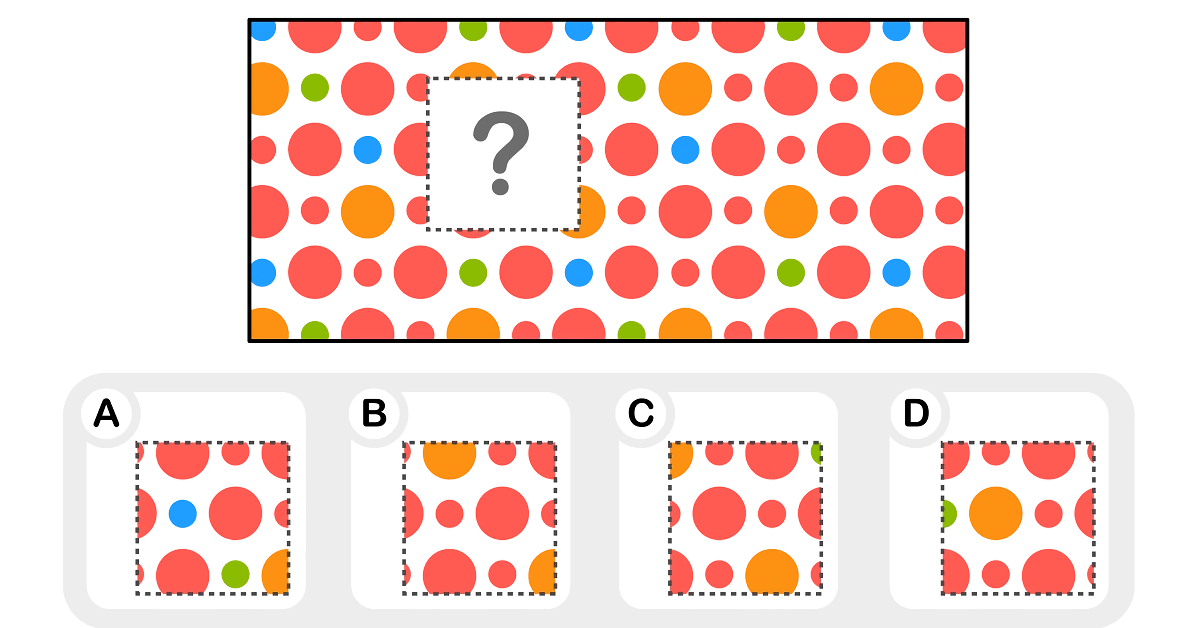
The challenge is straightforward: look at the pattern of colored circles, study their sizes and positions, and decide which of the four options—A, B, C, or D—correctly completes the missing section.
And there’s a catch: the missing area contains several circles, so you need to consider color, size, and position together.
Can You Spot the Pattern?
The image contains rows of circles in different colors and sizes. Most of the circles are red, but you can also see orange, blue, and green circles scattered throughout the pattern.
At first glance, the arrangement may appear random. However, there is a repeating structure hiding in the rows.
Start by looking at the circles immediately surrounding the missing square. Notice how their colors and sizes continue in recognizable sequences.
For example, some rows contain combinations of large red circles followed by smaller circles, while other rows introduce orange, blue, or green circles at specific positions.
The trick is not to focus on just one circle. Instead, compare the entire sequence across the rows and columns.
The Four Choices
You have four possible answers:
- A includes a blue circle in the middle section.
- B contains an orange circle followed by smaller red circles and a large red circle.
- C introduces a different combination of orange, red, and green circles.
- D contains a green circle and a large orange circle in its middle row.
Only one option continues the surrounding pattern correctly.
The Answer Is B
If you chose B, you spotted the pattern correctly.
The key is the top portion of the missing area. The circles visible immediately outside the missing section indicate that the sequence should continue with a small red circle, a large orange circle, another small red circle, and a large red circle.
Option B matches that sequence.
The rest of the circles in the option also fit the size and color arrangement of the surrounding pattern, making B the best completion.
Does Solving It Mean You Have a High IQ?
Not necessarily.
These viral puzzles are often described as “IQ tests,” but solving one visual puzzle cannot accurately determine someone’s IQ. Actual intelligence testing uses standardized tests, controlled conditions, and multiple types of reasoning tasks.
Still, puzzles like this are a fun way to challenge your visual perception, pattern recognition, attention to detail, and logical reasoning.
And if you solved it without looking at the answer, that’s definitely something to be proud of!
Final Challenge
Before scrolling away, try showing the puzzle to a friend without telling them the answer.
Can they find the missing pattern in under 30 seconds?
Answer: B.