
For centuries, people have asked the same impossible question:
What happens after we die?
Religions have offered answers. Philosophers have debated the question. And more recently, scientists have begun studying something that was once considered almost impossible to investigate: what people experience when they come close to death and survive.
Some survivors describe leaving their bodies.
Others report seeing a bright light, meeting deceased relatives, experiencing overwhelming peace, or feeling as though they are moving through another world.
Are these experiences evidence of an afterlife?
Science doesn’t have a definitive answer—but recent research has made the question even more fascinating.
What Is a Near-Death Experience?
A near-death experience, or NDE, is a profound experience reported by some people during situations involving a serious threat to life.
They have been particularly studied among survivors of cardiac arrest.
Reported experiences can include:
- A feeling of leaving the body
- Moving through darkness or toward a light
- Intense feelings of peace
- Encountering people or beings
- Reviewing memories
- A sense that time has changed
- Feeling separated from the physical world
- A powerful feeling of connection or meaning
Not everyone who survives cardiac arrest reports an NDE.
A 2024 review of prospective studies found reported NDE rates ranging from about 6% to 39%, depending on the study and setting.
That variation is one reason researchers continue to investigate the phenomenon.
The Strange Part: People Can Remember Something
One of the most intriguing aspects of NDE research is that some survivors report highly organized experiences despite having experienced cardiac arrest.
Researchers have therefore asked an extraordinary question:
How can people later remember conscious experiences from a period when their brains were severely compromised?
There is no universally accepted answer.
Some researchers argue that NDEs can be understood through changes occurring in the brain during extreme physiological stress. Others have argued that certain observations raise deeper questions about whether consciousness can be completely explained by brain activity.
The debate remains open.
Researchers Have Actually Studied Cardiac Arrest
This isn’t simply a collection of internet stories.
Researchers have conducted prospective studies involving people who experienced cardiac arrest.
One major project, known as AWARE-II, followed cardiac-arrest cases in multiple hospitals and incorporated EEG and cerebral-oxygen monitoring during CPR. Among the small group of survivors who completed interviews, some reported memories or perceptions associated with the arrest.
The study reported different categories of recalled experiences, including dream-like experiences and what researchers called a transcendent recalled experience of death.
But there’s an important limitation.
Only a small fraction of the original cardiac-arrest patients survived and completed the relevant interviews.
That makes the findings intriguing—but not proof that consciousness exists independently of the brain.
The Brain May Be More Active During Dying Than Once Thought
For a long time, the dying process was often imagined as a simple progression in which brain activity rapidly disappeared.
Modern monitoring has made the picture more complicated.
Research has detected electrical activity and changes in brain networks around cardiac arrest and resuscitation.
A 2024 medical review discussed evidence for changes in brain activity, including increased gamma activity and cortical connectivity in some circumstances surrounding cardiac and respiratory arrest.
This doesn’t mean that scientists have discovered an afterlife.
Instead, it tells us something equally important:
The human brain during the dying process may be considerably more complicated than previously assumed.
The Bright Light Mystery
Perhaps the most famous feature of near-death experiences is the bright light.
Some people describe moving toward an intense light or feeling surrounded by an extraordinary sense of warmth and peace.
But there are several possible explanations.
Changes in oxygen levels, brain activity, visual processing, neurotransmitters, and other physiological processes may influence perception during extreme conditions.
A 2025 neuroscience review proposed a model in which psychological and neurophysiological processes work together to produce the rich experiences reported during NDEs.
That explanation doesn’t necessarily settle the philosophical question.
It does, however, provide a scientific framework for investigating what people experience.
What About Seeing Yourself From Above?
Another commonly reported phenomenon is the out-of-body experience.
People sometimes describe feeling as though their consciousness has separated from their physical body.
Some report observing themselves from a different perspective.
This is particularly interesting to researchers because our sense of bodily location depends on the brain integrating information from vision, touch, balance, and other sensory systems.
Disruptions in those systems can produce powerful changes in the perception of where “you” are located.
That provides one possible neurological explanation.
But the subjective experience can still be extraordinarily convincing to the person experiencing it.
The Most Controversial Question
Here’s where the debate becomes much more complicated.
If an NDE can be explained entirely by changes in the brain, does that mean there is no afterlife?
Not necessarily.
And if someone experiences vivid consciousness during cardiac arrest, does that prove consciousness can exist independently of the brain?
Also no.
Those are much larger philosophical conclusions than the available evidence can establish.
Researchers can study brain activity, physiology, memories, reported experiences, and behavior.
But proving or disproving an afterlife is a different kind of question.
Scientists Don’t All Interpret the Evidence the Same Way
This is one of the most important details often missing from sensational stories about NDEs.
There is active scientific disagreement.
A 2025 review in Nature Reviews Neurology presented a neuroscientific framework in which multiple psychological and neurophysiological mechanisms could contribute to NDEs.
Meanwhile, a 2025 narrative review in International Review of Psychiatry examined whether observations surrounding cardiac arrest might support the possibility of consciousness continuing beyond normal brain function. The authors presented that interpretation as a subject requiring continued investigation.
The fact that researchers disagree is not evidence that one side has secretly discovered the answer.
It means the question remains scientifically unsettled.
Why NDEs Can Change People’s Lives
Regardless of their ultimate explanation, near-death experiences can have profound effects on the people who report them.
A 2025 systematic review found that reported aftereffects can include reduced fear of death, greater appreciation for life, increased spirituality, and greater compassion. It also noted that some experiences can be confusing or distressing.
For the person who experienced one, the event may completely change how they think about existence.
Someone who once feared death may become less frightened.
Someone who previously felt disconnected from life may develop a stronger sense of purpose.
And someone may simply be left with a mystery they cannot explain.
Why This Research Matters
Studying NDEs isn’t only about answering the question of what happens after death.
It also gives researchers an unusual opportunity to investigate consciousness itself.
What exactly is consciousness?
How does the brain generate a sense of self?
Why do people experience vivid memories during extreme physiological events?
How does the brain construct our perception of time and space?
And what happens to those processes when the body is close to death?
These are fundamental questions about being human.
The Evidence Has a Limit
There is an important distinction between:
“People report experiencing something extraordinary near death.”
and
“Science has proven that people visited an afterlife.”
The first statement is supported by decades of research into NDE reports.
The second has not been established.
Researchers continue to investigate the phenomenon, and current evidence can be interpreted in different ways.
That distinction matters because extraordinary experiences deserve to be taken seriously without automatically turning them into proof of an extraordinary explanation.
So, Is There an Afterlife?
We still don’t know.
Science has not established that an afterlife exists.
It also hasn’t answered every question surrounding consciousness at the boundary between life and death.
What researchers have established is that near-death experiences are real experiences reported by a subset of people who survive life-threatening events, particularly cardiac arrest, and that these experiences can be psychologically profound.
The mechanisms behind them remain an active area of research.
And that’s perhaps the most fascinating part.
The Mystery Continues
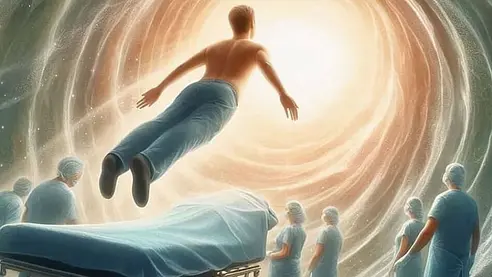
The image of a person rising above a hospital bed captures an idea that humans have imagined for thousands of years: that some part of us might exist beyond the physical body.
Whether that represents an actual separation of consciousness or an extraordinary experience generated by a brain under extreme conditions remains unresolved.
The research is getting more sophisticated.
The questions are getting deeper.
But the final answer to the biggest mystery of all may still be beyond what science can currently measure.
For now, the afterlife remains a question—not a proven scientific fact.