You buy good cheese, cook the pasta carefully, make a creamy sauce—and somehow your homemade mac and cheese still doesn’t taste like the comforting, silky version served at your favorite diner.
The problem may not be the cheese at all.
Diner-style mac and cheese often gets its distinctive texture and flavor from a few small techniques: properly cooked pasta, a well-balanced sauce, enough seasoning, and careful temperature control.
Here are the mistakes that may be keeping your homemade version from reaching that classic diner-style texture.
1. You’re Probably Overcooking the Pasta
It may seem harmless to cook the pasta until it’s completely soft, especially if you’re making baked mac and cheese.
But pasta continues cooking when it’s mixed with hot sauce and, in many recipes, when it goes into the oven.
If you start with overly soft pasta, the finished dish can become mushy.
Try This Instead
Cook the pasta until it’s just shy of your preferred texture.
If you’re baking the mac and cheese afterward, removing it from the water slightly earlier can help it hold its shape.
Always follow the cooking directions for the particular pasta you’re using.
2. Your Sauce Is Too Thick
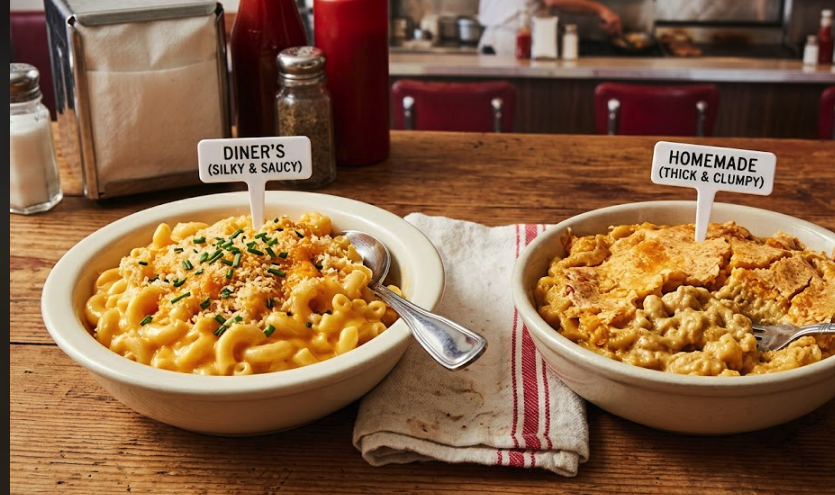
This is one of the biggest differences between homemade and diner-style mac and cheese.
A sauce that looks perfectly thick in the saucepan can become even thicker once it coats the pasta and cools.
The result can be heavy and clumpy rather than smooth and creamy.
A good cheese sauce should be creamy enough to coat the noodles while still flowing easily.
3. You’re Adding Cheese to a Pan That’s Too Hot
This is where many homemade sauces go wrong.
When cheese is exposed to excessive heat, its fats can separate from the rest of the sauce. Instead of becoming silky, the cheese may turn greasy, grainy, or stringy.
The Fix
Once your base sauce is ready, lower the heat—or remove the pan from the burner—before gradually adding the cheese.
Stir continuously as it melts.
Gentle heat is your friend.
4. The Pasta Water Matters
If you’re making stovetop mac and cheese, don’t overlook the water used to cook the pasta.
Pasta releases starch into the cooking water. A small amount of that starchy liquid can help loosen and bind a sauce.
Instead of adding large amounts of milk or cream when your sauce becomes too thick, try incorporating a little reserved pasta water.
Add it gradually until you reach the consistency you want.
5. You’re Underseasoning the Sauce
Cheese has plenty of flavor, but that doesn’t mean cheese alone provides enough seasoning.
Pasta and dairy can dilute flavors, especially when you’re cooking a large batch.
Salt is particularly important because properly seasoned pasta and sauce taste dramatically different from bland versions of the same recipe.
Taste the sauce before combining everything and adjust the seasoning gradually.
Black pepper, mustard powder, paprika, or a small amount of hot sauce can also add depth depending on the style you’re aiming for.
6. You’re Using Only One Type of Cheese
This isn’t a rule, but combining cheeses can give you a more interesting balance of flavor and texture.
A sharp cheddar can provide strong flavor, while a milder melting cheese can contribute smoothness.
The exact combination is up to you.
The important thing is choosing cheeses that melt well and complement each other rather than adding as many varieties as possible.
7. Pre-Shredded Cheese Isn’t Always Ideal
Bagged shredded cheese is convenient, but many varieties contain ingredients designed to prevent the shreds from sticking together.
Those coatings can sometimes affect how smoothly the cheese melts into a sauce.
For especially smooth mac and cheese, shredding cheese from a block can be worth the extra minute of preparation.
8. You’re Ignoring the Roux
For classic baked or stovetop mac and cheese, a simple butter-and-flour roux can provide structure for the sauce.
The key is cooking the flour enough to remove its raw taste without letting it become overly dark if you’re aiming for a light cheese sauce.
Gradually whisk in your milk rather than adding it all at once.
Once the mixture has thickened, you can begin adding your cheese.
9. You’re Baking It Too Long
Baked mac and cheese can be fantastic, but there’s a point where more oven time works against you.
Too much baking can cause the sauce to dry out while the pasta absorbs more moisture.
If you want a browned top, use enough heat and time to develop the crust without leaving the entire dish in the oven until the sauce becomes dry.
A short rest after baking also helps the sauce settle.
10. You’re Forgetting the Diner-Style Balance
That familiar diner flavor isn’t necessarily about using expensive ingredients.
It’s about balance.
You want enough salt to make the cheese taste lively, enough fat for richness, enough liquid for creaminess, and enough seasoning to keep the dish from tasting flat.
Texture matters just as much as flavor.
The noodles should remain distinct, while the sauce should cling to them without becoming pasty.
A Simple Diner-Style Formula
If you want to experiment with your next batch, keep this basic process in mind:
Cook the pasta: Stop just before it’s completely tender.
Make the sauce: Build a smooth dairy-based sauce and season it well.
Control the heat: Don’t aggressively boil the cheese.
Add cheese gradually: Stir until smooth before adding more.
Combine: Coat the pasta evenly.
Finish carefully: Serve stovetop for maximum creaminess or bake briefly for a browned top.
The Real Secret
The biggest difference between disappointing homemade mac and cheese and a great batch often isn’t a secret cheese blend.
It’s technique.
Control the heat. Don’t overcook the pasta. Season every component properly. Keep enough moisture in the sauce, and don’t bake the dish until it’s dry.
Once you get those fundamentals right, even an ordinary box of pasta and a few supermarket cheeses can produce a bowl of mac and cheese that’s rich, creamy, and deeply comforting.
And that’s probably much closer to the diner experience you’ve been trying to recreate.